

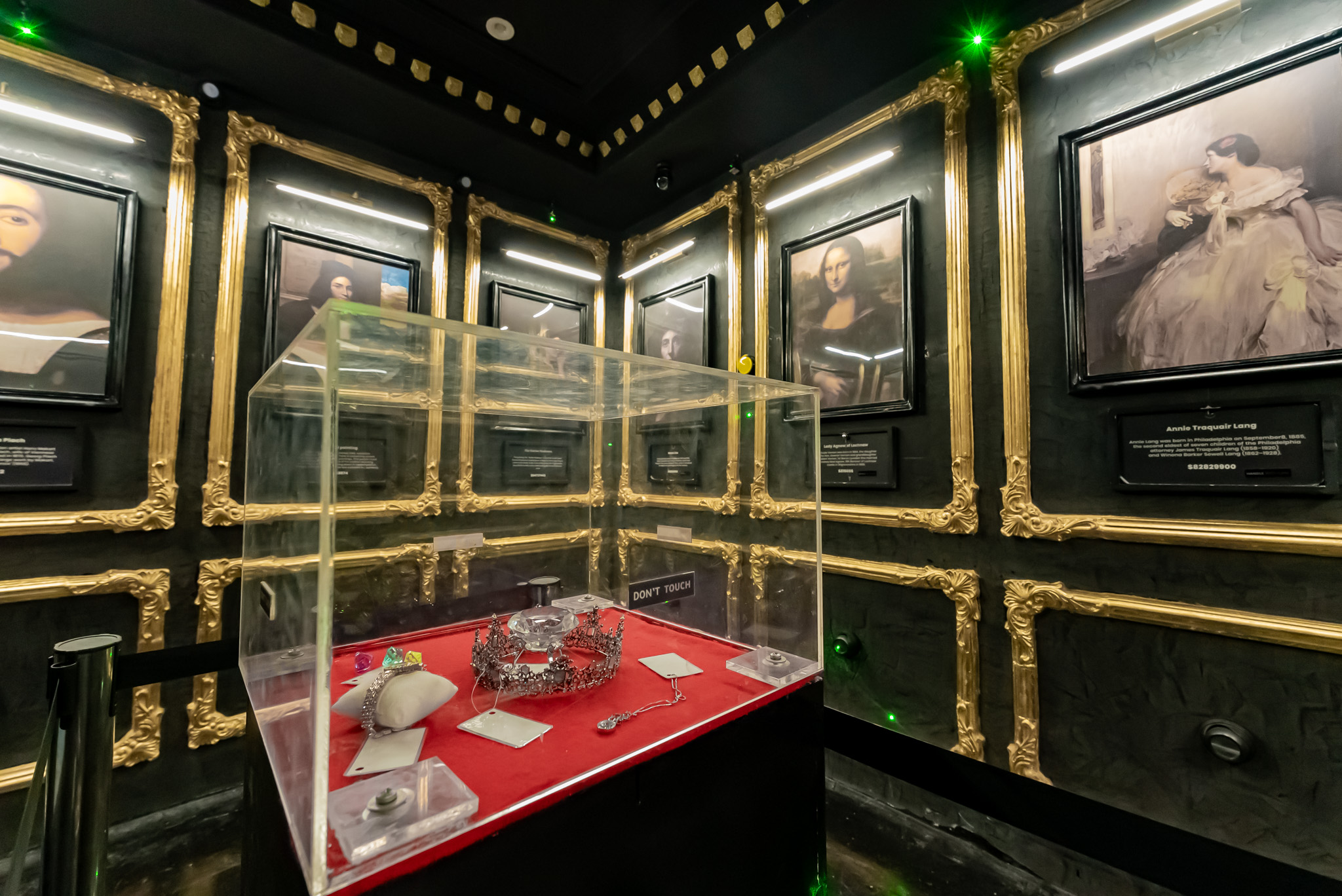
Escape Room Saudi Arabia
Imagine being locked in a room with your friends, a 60-minute timer counting down, and puzzles scattered across every surface. The pressure builds. You communicate differently than you ever do at work or at a dinner table. Someone spots a connection nobody else noticed. The lock clicks open. In that moment, something shifts — not just the door, but something between the people in the room.
That is the escape room experience. And in Saudi Arabia, it has gone from a niche curiosity to one of the fastest-growing entertainment investments in the Kingdom.
Whether you are a visitor looking for the best escape room experience, or an investor thinking about building your own facility, this guide covers everything you need to know about escape rooms in Saudi Arabia in 2026.
An escape room — also called a “skip room” (سكيب روم) in Arabic — is a live-action, immersive entertainment experience where a group of participants (typically 2–10 people) enters a specially designed room or series of rooms and must solve puzzles, find clues, and complete objectives within a set time limit, usually 60 minutes.
Every element of the room is designed with intention: the story, the visual theme, the props, the lighting, the sound design, and the puzzles. A well-designed escape room feels completely believable — participants forget they are in an entertainment venue and feel genuinely immersed in the narrative.
The experience works because it creates controlled pressure in a safe context, which unlocks different modes of thinking and different dynamics between participants than ordinary social situations ever produce.
Saudi Arabia’s entertainment sector transformation under Vision 2030 has been one of the most dramatic shifts in the Kingdom’s social landscape. The General Entertainment Authority (GEA) has licensed and promoted hundreds of entertainment concepts previously unavailable in the country, and escape rooms have been among the most eagerly adopted.
The market has grown steadily since 2019 and continues to expand. Key drivers include:
A young, experience-hungry population. Over 60% of Saudi Arabia’s population is under 35 — exactly the demographic that most enthusiastically seeks interactive, social entertainment experiences.
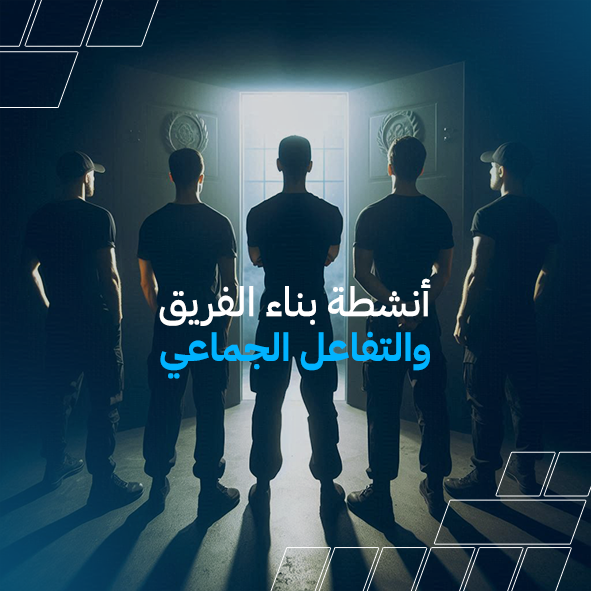
Corporate Team Building demand. As Saudi companies increasingly prioritize employee experience and organizational culture, escape rooms have become a standard tool for team building activities. Companies from Aramco to emerging tech startups use escape room experiences to develop communication and collaboration.
Family and group entertainment gap. Families in Saudi Arabia have historically had fewer entertainment options for mixed-age groups. Escape rooms — particularly adventure and children’s themes — fill this gap well.
Tourism and hospitality growth. As Saudi Arabia aggressively develops its tourism sector, entertainment venues targeting visitors have become a priority for investors. Escape rooms with strong thematic design attract both domestic and international visitors.
The escape room industry has evolved well beyond the original “locked room with padlocks” format. Modern escape rooms span several distinct categories:
The most broadly appealing category. Adventure themes typically involve quests, treasure hunts, ancient mysteries, or exploration scenarios. They work across age groups and cultural contexts, making them the most commercially reliable choice for first-time escape room investors in Saudi Arabia.
Puzzle complexity and physical demands can be calibrated for family groups or more challenging adult experiences.
Designed for adrenaline and intense atmospheric immersion. Horror escape rooms use controlled fear — sound design, darkness, unexpected sensory elements — to create peak experiences. They consistently attract repeat visitors because the emotional intensity creates strong memories.
In the Saudi market, horror escape rooms skew toward teen and young adult audiences. Design must be carefully calibrated to avoid content that conflicts with local cultural sensitivities while still delivering genuine thrills.
Modeled on spy thrillers and action films. Participants complete missions against the clock with mechanical, electronic, and physical puzzle elements. Action themes often incorporate movement, multiple room sequences, and increasing intensity. They are particularly popular for corporate team building.
Simplified puzzles, bright visual design, and gentle storytelling make children’s escape rooms one of the fastest-growing categories in Saudi Arabia. They serve a significant unmet need — entertainment experiences that engage children ages 5–14 with age-appropriate challenge and genuine excitement.
Futuristic settings combined with technology-driven puzzles — augmented reality elements, interactive holograms, electronic lock sequences — create experiences that showcase what modern escape room design can achieve. Sci-fi themes signal design sophistication and attract the most tech-curious visitor segments.
Corporations commission branded escape rooms built around their products, brand story, or training objectives. These are typically not public-facing venues but rather purpose-built experiences for employee development, client entertainment, or marketing activations.
For investors evaluating entertainment concepts, escape rooms present an unusually attractive business case:
Relatively low operating costs post-launch. Unlike food and beverage operations, escape rooms have no consumable inventory, no perishable goods, and limited staffing requirements per session. After the initial capital investment in design and fabrication, ongoing costs are primarily staff salaries, maintenance, and utilities.
High repeat visitation potential. Visitors who have completed a room will return to try new themes. A facility that regularly introduces new room concepts builds a loyal repeat customer base — something few entertainment formats achieve naturally.
Multiple revenue streams. Core ticket sales, corporate team building packages (which command premium pricing), birthday party bookings, branded event packages, and merchandise all contribute to escape room revenue.
Scalability. A successful single-room operation can add rooms incrementally, with each new room adding revenue capacity without proportionately increasing overhead.
Clear pricing power. Quality escape rooms in Saudi Arabia typically price between SAR 60–120 per person per session. A single 6-person session generates SAR 360–720 in 60 minutes. A well-operated facility running 8–10 sessions per day across multiple rooms generates strong revenue with consistent demand.
Escape room construction costs vary significantly based on design ambition, room size, puzzle complexity, and technology integration. Here is a realistic cost framework for Saudi Arabia:
A single room (25–50 sqm) with strong thematic design, mechanical and electronic puzzles, professional lighting, and sound design. Suitable for first-time operators testing the market. Delivers a genuine experience without advanced technology integration.
Full custom design, premium fabrication quality, electronic puzzle systems, advanced lighting and atmospheric effects, and a game master control station. This investment level produces the experiences that generate consistent positive reviews and repeat visitation.
AR/VR elements, custom-programmed electronic systems, animatronics, custom game master software, and fully immersive multi-room sequences. This is the investment level required for destination experiences that attract visitors from outside your immediate area.
Key investment variables:
Understanding the build process helps you evaluate potential design partners and avoid costly mistakes.
Everything begins with the narrative. What is the story your room will tell? Who is the protagonist? What is at stake? A strong story provides the framework for every subsequent design decision. Puzzle designers work from story logic — clues should feel organic to the narrative, not arbitrary.
This stage also defines the target audience, the difficulty calibration, the number of players per session, and the spatial requirements.
Puzzle design is a specialized discipline. Good puzzles are logical in retrospect (players feel smart for solving them, not lucky), scaled to appropriate difficulty for your target audience, and diverse in type (spatial, logical, observational, physical). A professional escape room typically contains 12–20 distinct puzzle elements arranged in a non-linear structure.
Puzzle designs are tested extensively before fabrication begins. Poor puzzle design discovered after fabrication is extremely expensive to fix.
Converting the concept into physical reality — walls, flooring, ceilings, structural elements, lighting infrastructure, ventilation, and emergency exit compliance. In Saudi Arabia, specific building codes and safety regulations govern public entertainment venues, and experienced operators ensure compliance from the design stage.
Taqueen handles the complete fabrication process in-house at its Khobar facility, allowing quality control and timeline management that outsourced manufacturing cannot match.
Installing electronic puzzle systems, audio systems, lighting control, CCTV monitoring, and the game master control interface. This stage requires coordination between structural fabrication and systems integration — ideally managed by a single partner rather than multiple contractors.
Before opening, every room undergoes extensive playtesting — typically 10–15 test sessions — to verify puzzle logic, identify flow problems, calibrate timing, and train game masters. Shortcutting this stage is a common and costly mistake.
Having visited and analyzed escape rooms across the region, these are the consistent differentiators between operations that thrive and those that struggle:
Story coherence. Every element — props, puzzles, sounds, visuals — reinforces the narrative. Nothing feels out of place or arbitrary.
Puzzle elegance. The best puzzles are surprising to encounter and satisfying to solve. They reveal themselves gradually and reward observation. They never require knowledge that players couldn’t reasonably have.
Atmospheric immersion. Sound design and lighting do more for immersion than almost any other element. Rooms that scrimp on these feel hollow regardless of fabrication quality.
Game master quality. The game master — who monitors the session and provides hints — is the human element of the experience. Well-trained game masters balance support with allowing genuine discovery moments. This is a skill that requires proper training.
Safety without intrusion. Emergency exits, ventilation, climate control, and reliable electronic systems must all work flawlessly. Safety failures are catastrophic for an escape room’s reputation in the social-media-driven Saudi market.
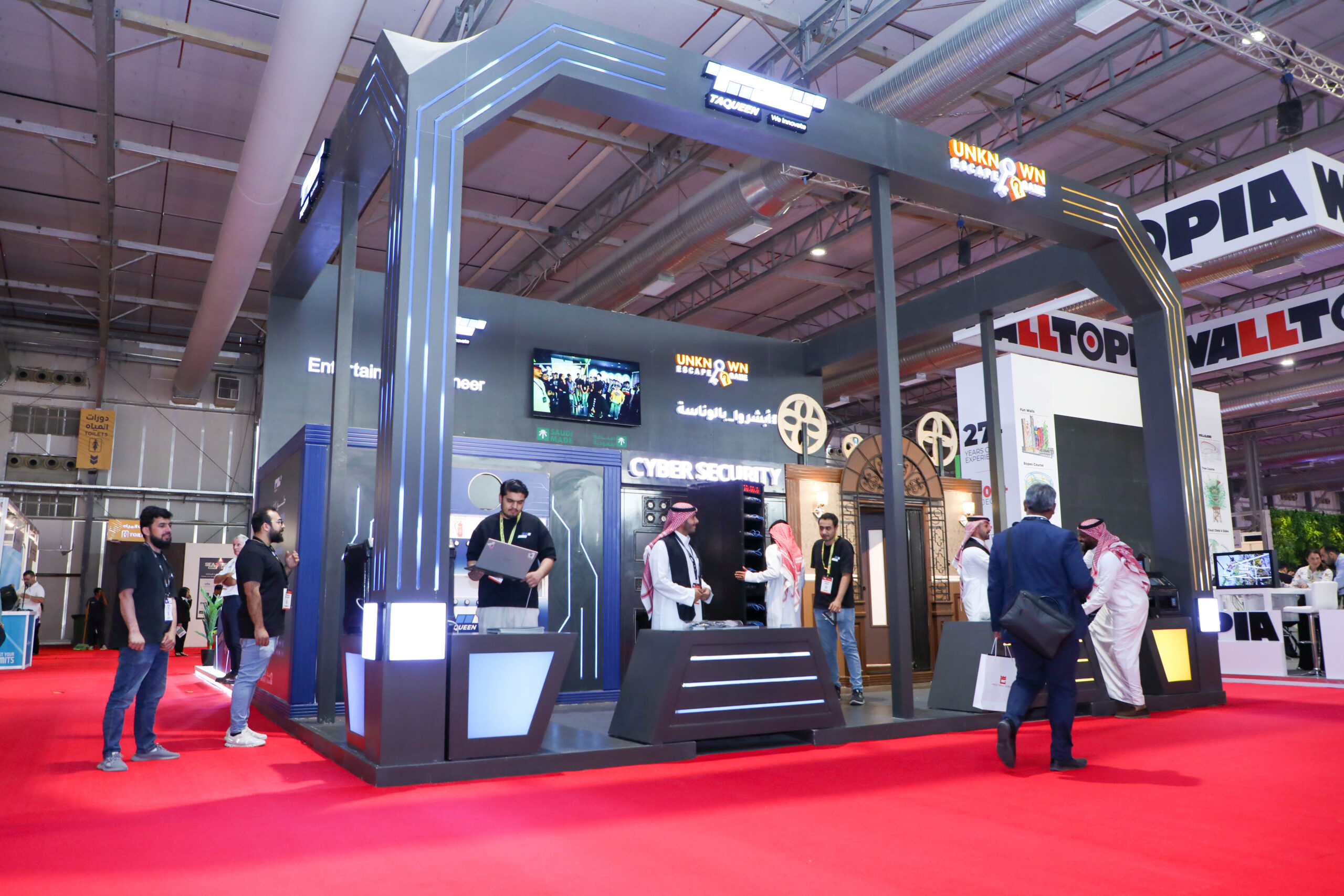
Taqueen is one of Saudi Arabia’s leading escape room design and fabrication companies. Operating from our manufacturing facility in Khobar, we have delivered immersive escape room installations across the Kingdom — from single-room entertainment venues to multi-room destination experiences.
Our escape room service includes:
Our project timeline:
How many players can participate in an escape room?
Most escape rooms accommodate 2–8 participants per session. Some larger rooms handle up to 12. Optimal group size varies by room design — discuss with your operator.
Are escape rooms suitable for children in Saudi Arabia?
Yes, with appropriate theme selection. Children’s theme escape rooms are specifically designed for ages 5–14 with calibrated puzzle difficulty and age-appropriate content.
How long does a typical escape room session last?
60 minutes is the standard. Some facilities offer 45 or 75 minute formats.
Can escape rooms be booked for corporate events?
Absolutely. Corporate team building packages including dedicated sessions, facilitator support, and post-session debrief are one of the most popular bookings for escape room operators in Saudi Arabia.
Do I need a license to operate an escape room in Saudi Arabia?
Yes. Entertainment venues in KSA require licensing through the General Entertainment Authority (GEA). Experienced operators and design partners like Taqueen are familiar with these requirements.
Whether you are planning your first escape room investment or expanding an existing entertainment facility, Taqueen brings the design expertise, fabrication capability, and local market knowledge to deliver an experience your visitors will talk about — and return to.
Contact us for a free consultation:
you can reach us from here
📧 info@taqueen.sa
📞 +966 556 673 701
🌐 taqueen.sa